which is stronger thca or delta 8
THCa vs Delta-8: Which Is Stronger?
Which is stronger THCa or Delta-8, here’s the straight answer: once it’s heated, THCa is the stronger of the two, and it isn’t close. THCa itself doesn’t get you high in its raw form, but the moment you light it or vape it, it converts into Delta-9 THC, the most potent common form of THC. Delta-8, by contrast, is already active but noticeably milder, often described as about half the strength of Delta-9.
That’s the short version. The longer version is where it gets useful, because “stronger” depends on how you use each one, and the two work in completely different ways. After years of fielding this exact question across the counter, I’ve learned the number on the label almost never tells the whole story.
Quick answer: THCa vs Delta-8 strength
- Raw, unheated: Delta-8 is stronger. THCa is non-intoxicating until heat activates it, so raw THCa won’t get you high at all.
- Heated (smoked, vaped, dabbed): THCa is much stronger. Heat turns it into Delta-9 THC, while Delta-8 stays about half as potent as Delta-9.
- Most users report THCa’s activated effects feel roughly twice as strong as Delta-8.
- Bottom line: if raw potency is the question, heated THCa wins. If you want a gentler, clearer experience, Delta-8 is the milder choice by design.
The core difference: raw acid vs already active
The single thing that trips people up is that THCa and Delta-8 aren’t the same kind of thing. Comparing them head-to-head is a bit like comparing raw dough to a slice of bread: one needs the oven, the other is ready to eat.
THCa (tetrahydrocannabinolic acid) is the raw, acidic form of THC found in fresh, unheated cannabis and hemp flower. In this state it’s non-intoxicating. It only becomes the THC everyone knows through a reaction called decarboxylation, which is just a technical word for what heat does to it.
Delta-8 THC is already psychoactive the moment you consume it. It’s a close chemical cousin of Delta-9 THC, differing by the position of a single double bond in the carbon chain, and that tiny shift is what makes it milder.
So the honest framing of “which is stronger” is this: THCa has a higher ceiling but needs heat to reach it, while Delta-8 has a lower ceiling but gets there on its own.
How strong is THCa, really?
The key is what heat does. When you smoke, vape, or dab THCa, decarboxylation converts it into Delta-9 THC, the primary intoxicating compound in cannabis. That’s why a THCa flower testing at 25% can feel just like high-potency dispensary weed: because, once lit, that’s essentially what it becomes.
Two practical points matter here:
- Conversion isn’t 100%. Depending on temperature and method, roughly 75% to 88% of THCa converts to usable THC. The rest is lost.
- The label math. Many lab reports show “Total THC,” calculated as Total THC = (THCa × 0.877) + Delta-9 THC. The 0.877 factor accounts for weight lost during conversion. A flower at 25% THCa and 1% Delta-9 works out to around 22.9% real-world potency.
That activated potency is why, gram for gram, quality THCa flower can match or beat what you’d get from a dispensary. It behaves like full-strength Delta-9, because chemically that’s what you’re inhaling.
How strong is Delta-8?
Delta-8 is genuinely psychoactive, so the “it doesn’t really do anything” take is wrong. It just does less. Both Delta-8 and Delta-9 attach to the same CB1 receptors in the brain, but Delta-8 binds less tightly, which is why the effect is weaker. Older research and modern user reports line up on the same rough figure: Delta-8 is about half as potent as Delta-9, so you’d need more of it to reach the same level.
Most people describe the Delta-8 experience as lighter, clearer, and more functional, with less of the anxiety or paranoia that a strong Delta-9 dose can bring. That’s its whole appeal, and why it picked up the “diet weed” nickname.
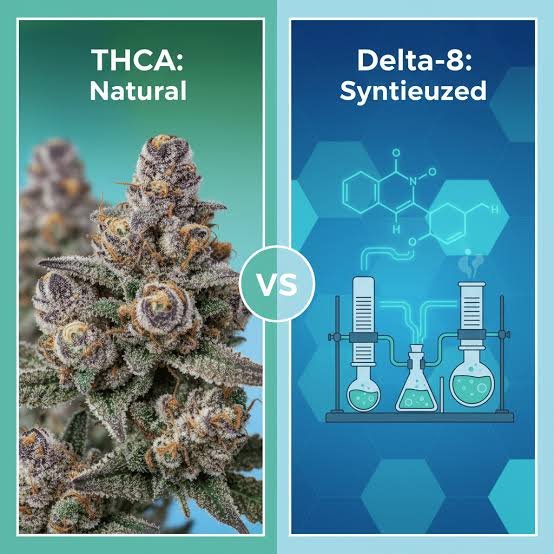
One production note worth knowing: hemp plants contain very little Delta-8 naturally, so nearly all Delta-8 on the market is made by chemically converting hemp-derived CBD in a lab. That manufacturing step matters for both quality and, as you’ll see below, legality.
THCa vs Delta-8: head-to-head comparison
| Factor | THCa | Delta-8 |
|---|---|---|
| Active when raw? | No, non-intoxicating until heated | Yes, active as sold |
| Converts to | Delta-9 THC (via heat) | Stays Delta-8 |
| Relative strength | High, equals Delta-9 once heated | Milder, about half of Delta-9 |
| Typical experience | Full, classic THC high | Lighter, clearer, less anxious |
| How it’s made | Grown naturally in hemp/cannabis flower | Usually lab-converted from CBD |
| Best for | Experienced users wanting full potency | Beginners or anyone wanting a gentle effect |
| Onset feel | Strong, can be intense | Smooth, more functional |
So which is stronger? Heated THCa, clearly. It becomes Delta-9 THC, and Delta-9 outguns Delta-8 roughly two to one. But “stronger” and “better” aren’t the same word, which is where your own goals come in.
Which one should you choose?
Strength is only useful if it matches what you’re after. Here’s how I usually steer people:
- You want the full, classic high: THCa flower or vapes. Heated, it delivers true Delta-9 potency.
- You’re new, or sensitive to THC: Delta-8. The milder, clearer effect is far more forgiving, and much less likely to tip into anxiety.
- You want daytime function: Delta-8 tends to feel lighter and less couch-locking for many users.
- You’re price- and potency-focused: THCa flower usually gives the most actual THC per dollar, since you’re buying something that converts to full-strength Delta-9.
- You don’t plan to heat it: neither raw THCa nor most edibles behave the way you’d expect. Raw THCa won’t get you high, and that surprises a lot of first-timers.
There’s no universally “better” option. The right pick depends on your tolerance, your goal, and increasingly, as the next section covers, what’s actually legal where you live.
Is THCa or Delta-8 legal? (2026 update)
This is the part that’s changing fast, so don’t rely on an older article. Both cannabinoids rode the same “hemp loophole” from the 2018 Farm Bill, which legalized hemp with under 0.3% Delta-9 THC by dry weight. That’s how THCa flower and lab-made Delta-8 reached shelves nationwide. In late 2025, Congress rewrote the definition of hemp, and the change lands in two steps:
- November 12, 2026 (in effect): products with cannabinoids that can’t be naturally produced by the plant, which covers most lab-converted Delta-8, lost their hemp status and are now treated as controlled substances federally.
- December 11, 2026 (scheduled): a broader shift to a “total THC” standard with a cap of 0.4 mg per container. Because THCa counts toward total THC, this would pull most high-THCa hemp flower out of the legal hemp category too.
In plain terms: Delta-8’s federal footing is already gone, and THCa flower’s is on a very short clock. State law adds another layer, and some states already ban one or both. Always confirm the current rules for your state before buying or selling, and treat this section as a snapshot, not legal advice.
My take from behind the counter
Note to you (not for publishing): I didn’t invent customer quotes or fake case studies. The prompts below are where your real experience should go, and that first-hand detail is exactly what Google’s E-E-A-T rewards and what competitors’ generic posts lack. Replace each bracket with your own story, then delete this note.
If I had to sum up years of this question in one line: people ask which is stronger, but what they usually want is which is right for them. The strength answer is THCa. The satisfaction answer is more personal.
- [Your case study 1 — a THCa customer: e.g., an experienced smoker who switched to THCa flower and how its potency compared to dispensary product for them.]
- [Your case study 2 — a Delta-8 customer: e.g., someone sensitive to regular THC who found Delta-8’s milder effect worked where Delta-9 didn’t.]
- [Your most common misconception: e.g., the customer who kept eating raw THCa expecting a high and got nothing, and what you told them.]
- [Your honest opinion: where you land when someone asks you directly, and any caveat you always add.]
My standing advice: start low, know whether you’re going to heat it, and buy only from sellers who show a current lab report (COA) you can actually verify.
Frequently asked questions
Which is stronger, THCa or Delta-8?
Once heated, THCa is stronger. It converts into Delta-9 THC, which is about twice as potent as Delta-8. Raw and unheated, though, THCa does nothing, so Delta-8 is “stronger” only in that specific uncooked state.
Does THCa get you high?
Not in its raw form. THCa only becomes intoxicating after decarboxylation, meaning heat from smoking, vaping, or dabbing, which turns it into Delta-9 THC.
Is Delta-8 or Delta-9 stronger?
Delta-9 is stronger, roughly 1.5 to 2 times as potent as Delta-8. Since heated THCa becomes Delta-9, that’s why THCa outranks Delta-8 on strength.
Will THCa or Delta-8 show up on a drug test?
Yes, both can. Standard tests look for THC metabolites, and both THCa (once converted) and Delta-8 can trigger a positive result. If you’re tested, avoid both.
Is Delta-8 natural?
Usually not. Hemp contains very little Delta-8, so almost all commercial Delta-8 is chemically converted from CBD in a lab. That’s also why it’s caught up in the 2026 federal hemp changes.
Sources